


What is mortise and tenon joinery and why does it matter in a timber frame pavilion?
Mortise and tenon joinery is the foundation of authentic timber frame construction. It has been used in the structural framing of buildings, bridges, and furniture for over 7,000 years — and for good reason.
How it works:
- A tenon (projecting tongue) is precision-cut on the end of one timber
- A matching mortise (cavity) is cut into the receiving timber
- The tenon slides into the mortise; the joint is then secured with a wooden peg or structural fastener
- The result is an interlocking mechanical connection that distributes load across a large timber-to-timber bearing surface
Why it outperforms bolt-and-bracket systems:
- No metal connector to corrode, loosen, or fail over decades of seasonal expansion and contraction
- The large timber-to-timber contact area creates dramatically more rigidity than point-contact bolt connections
- Eliminates visible hardware — the finished structure has a clean, uninterrupted aesthetic
- Self-tightening over time — the wood compresses slightly around the joint as it seasons
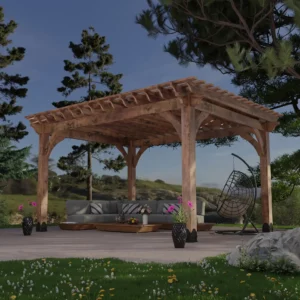
NORWEH’s Pavilion HT features traditional mortise and tenon joinery throughout. It’s the reason this structure is built to last generations, not just seasons.