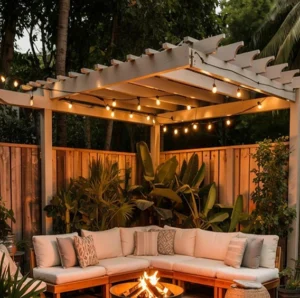
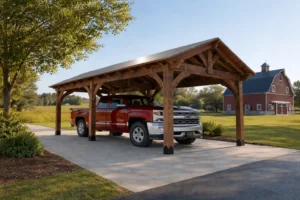
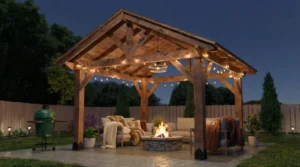
Your outdoor pavilion is more than just a backyard feature, it’s an architectural investment in family living, outdoor comfort, and long-term property value. The material you choose defines not only how it looks, but how it performs year after year. Strength, weather resistance, dimensional stability, and aesthetics all play a critical role in determining whether your structure will endure or deteriorate.
Among the premium timber options available today, Douglas Fir stands as the professional’s choice for outdoor construction. It combines remarkable structural performance with natural beauty and sustainability. For builders and homeowners who demand reliability and refined craftsmanship, Douglas Fir offers the perfect balance between strength and sophistication.
Structural Strength and Performance
Douglas Fir is renowned for its exceptional strength-to-weight ratio, outperforming most other softwoods used in structural applications. Its high modulus of elasticity allows the timber to flex under heavy loads, such as snow, wind, or movement, without permanent deformation. This makes it ideal for outdoor pavilions that must remain stable in diverse environmental conditions.
Grade No. 1 Structural Douglas Fir is capable of supporting snow loads of up to 40 pounds per square foot, equivalent to roughly two to three feet of snow accumulation. This load-bearing ability ensures that roof structures remain sound even in northern climates with severe winters.
The wood’s dense, uniform grain provides excellent fastener-holding power, essential for both traditional joinery and modern metal connectors. Outdoor structures constantly experience expansion and contraction due to temperature and humidity fluctuations. Douglas Fir’s consistent grain pattern helps prevent splitting or joint loosening, ensuring that structural integrity is maintained over decades of use.
Weather Resistance and Durability
Outdoor pavilions must withstand moisture, sunlight, and extreme temperature swings. Douglas Fir naturally resists decay and moisture intrusion due to its dense cellular structure and resin content. While no wood is entirely immune to the elements, Douglas Fir’s tight grain limits water absorption, reducing the risk of warping, cracking, or damage from freeze-thaw cycles.
When treated with high-performance penetrating oils such as CUTEK®, the wood becomes exceptionally resistant to UV radiation, water ingress, and fungal growth. This finishing system allows the timber to breathe while preserving its strength and color.
From the humid Southeast to the snow-heavy Pacific Northwest, Douglas Fir has proven its resilience through decades of outdoor use across the United States. Properly finished and maintained, it delivers decades of dependable service with far lower maintenance costs than pressure-treated pine or lower-grade softwoods.
Aesthetic Qualities and Finish Acceptance
Beyond its strength, Douglas Fir offers distinctive aesthetic appeal. Its warm, honey-toned heartwood and refined grain pattern lend a sophisticated yet natural character to outdoor architecture. The visual consistency of Douglas Fir complements both traditional timber-frame and contemporary minimalist pavilion designs.
Unlike cedar or untreated pine, Douglas Fir doesn’t simply gray or deteriorate, it develops a rich patina that enhances its appearance over time. The wood’s even texture ensures that stains and finishes apply uniformly, maintaining color consistency across large timbers and complex structures. This finish acceptance makes it ideal for projects where appearance must match the high standards of structural performance.
The ability to combine visible craftsmanship with structural reliability is what gives Douglas Fir pavilions their timeless visual appeal. It’s a durable wood that looks as strong as it performs.
Grading Standards and Quality Assurance
Choosing Grade No. 1 Structural Douglas Fir ensures that every timber meets strict standards for strength, knot size, grain slope, and overall appearance. This grading system provides builders and engineers with verified performance data used in structural design and code compliance.
The difference between lower grades and structural-grade timber is significant. Grade No. 1 provides fewer knots, tighter grain, and greater uniformity, qualities that directly translate into better load capacity, longevity, and appearance. For professional outdoor construction, these standards are non-negotiable.
By sourcing and building exclusively with verified structural-grade materials, NORWEH Timber Frame guarantees consistency, safety, and long-term performance across every pavilion project.
Sustainability and Responsible Resource Management
Douglas Fir is one of North America’s most responsibly managed timber varieties. It reaches harvest maturity in 40–60 years, far faster than most hardwoods, making it a renewable and environmentally sustainable choice.
Sustainable forestry operations ensure continuous replanting and forest health, maintaining an ongoing supply of high-quality material. Furthermore, Douglas Fir’s long service life contributes to environmental efficiency. A pavilion that lasts 50 or more years uses fewer resources and generates less waste than structures built from cheaper, short-lived materials.
Lifecycle assessments consistently show that durable materials like Douglas Fir reduce the overall carbon footprint by minimizing the need for replacements or frequent maintenance. In essence, choosing Douglas Fir supports both ecological stewardship and economic sense.
Precision Craftsmanship and Construction Methods
At NORWEH Timber Frame, each Timber Frame Pavilion begins with Grade No. 1 Douglas Fir, expertly cut, shaped, and assembled with precision-engineered joinery that enhances the wood’s natural strength while achieving clean, architectural lines.
Every component receives a professional CUTEK® penetrating finish to protect against moisture and UV exposure. This combination of superior material and expert craftsmanship results in a structure that performs reliably across all climates while maintaining its aesthetic integrity for decades.
Also Read: Backyard Seating Ideas: Create a Peaceful Spot for Relaxation
Long-Term Value and Cost Efficiency
While Douglas Fir requires a higher initial investment compared to pressure-treated or lower-grade softwoods, its total cost of ownership is significantly lower. Its superior strength, weather resistance, and stability drastically reduce maintenance, repair, and replacement costs over time.
In contrast, structures built with inferior materials often need major repairs or full replacement within 10 to 20 years. A well-built Douglas Fir pavilion, properly maintained, can easily last 40 to 50 years with minimal upkeep, delivering consistent performance and enduring visual appeal.
For discerning homeowners and builders, Douglas Fir represents true long-term value: performance and beauty that justify every dollar spent.
Also Read: Convert Your Outdoor Living Space into a Cozy Garden Lounge
Conclusion
Douglas Fir continues to define the standard for high-performance outdoor pavilions, balancing strength, durability, aesthetics, and sustainability in one material. Its proven engineering properties, excellent finish acceptance, and renewable sourcing make it a trusted choice for architects and craftsmen alike.
At NORWEH Timber Frame, every Timber Frame Pavilion is built from premium, Grade No. 1 Douglas Fir, crafted with precision joinery, advanced protective finishes, and Scandinavian-inspired design integrity. The result is a structure that doesn’t just withstand the seasons, it defines them.
A Douglas Fir pavilion isn’t merely built for today; it’s built to stand beautifully for generations.