


Can I install a NORWEH pavilion attached to my house?
This is one of the most common questions we receive, and it’s worth explaining both why the standard kits are freestanding and what your options are if attachment is specifically what you need.
Why standard NORWEH kits are freestanding — and why that’s usually the right call
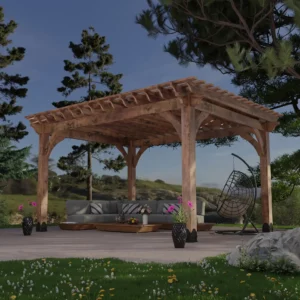
NORWEH’s standard Pavilion HT, Pavilion LT, and Pergola kits are engineered as fully freestanding structures. This is a deliberate design decision, not a limitation, and it works in your favor in several ways:
- No water intrusion risk: The most common problem with attached outdoor structures is the junction between the structure’s roof and the home’s exterior wall. This is a notoriously difficult detail to waterproof permanently — even well-installed flashings can fail over years of thermal cycling. Freestanding eliminates this risk entirely
- Full placement flexibility: Position the pavilion anywhere in your yard — beside the house, at the pool, in a garden — without being constrained by your home’s wall configuration
- Simpler permitting: Freestanding accessory structures are classified differently from attached additions in most US building codes; they typically require less engineering review and simpler permit applications
- No structural dependency: The pavilion does not rely on your home’s framing for structural support — it stands and performs independently regardless of what’s adjacent to it
How close can a freestanding pavilion sit to the house?
A freestanding NORWEH pavilion can be positioned very close to the home — as little as 1–2 feet from the exterior wall — while remaining technically freestanding. This gives you all the visual and functional effect of an attached structure while avoiding the technical and permitting complexity of a true attachment. A connecting pathway of pavers or a low step bridges any small gap seamlessly.
If you genuinely need an attached structure: NORWEH Custom
If your specific situation requires the pavilion to structurally connect to your home — for example, to share a roofline, attach to a second-story deck, or integrate with an existing architectural feature — the NORWEH Custom option can be engineered for that configuration.
- An attached structure requires a ledger board connection into your home’s rim joist or structural framing — this must be assessed by a structural engineer
- NORWEH’s team will arrange engineered structural drawings specific to your home’s framing configuration
- Most US municipalities require these drawings plus a more detailed permit application for attached structures — our team guides you through this process
- Proper flashing and waterproofing at the house-structure junction is critical and must be professionally installed
To discuss a custom attached configuration, call +1 (866) 610-0610 or visit norweh.com/product/norweh-custom. Our team will review your home’s plans, discuss the structural requirements, and give you an honest assessment of the best approach for your specific situation.