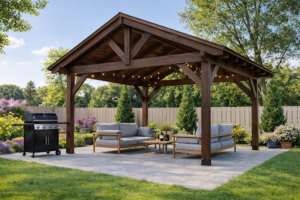
Do You Need a Permit for a Pavilion? What US Homeowners Should Know
Planning a backyard pavilion is an exciting step, but somewhere between choosing a size and picturing the finished space, most homeowners run into the same



Most homeowners who decide on a pavilion arrive at the same follow-up question almost immediately: how big should it actually be? Pavilion size is not simply a question of square footage. It is a question of how the space will be used, who will occupy it, and how it relates to the broader property.
Get the size right and the pavilion becomes the most-used space on the property. Get it wrong and even a well-built structure can feel either cramped or disproportionate to its surroundings. This guide walks through the key sizing considerations, what different pavilion build configurations look like in practice, and how pavilion size affects overall cost.
Choosing a pavilion size is one of the most consequential decisions in the entire build process, yet it is frequently treated as an afterthought. A structure too small for its intended use will feel restrictive within a single season, while one disproportionate to the yard can dominate the space and limit how the rest of the property functions.
The right pavilion size is determined by three factors: the primary use case, the number of people the space needs to accommodate, and the available footprint of the yard. A pavilion intended for quiet evening use has meaningfully different requirements from one designed to host extended family gatherings or incorporate an outdoor kitchen.
Understanding these parameters before committing to a pavilion build prevents the most common sizing mistake: choosing dimensions based on a floor plan rather than on how the space will feel and function when furnished and occupied.
For yards with a modest footprint, a pavilion size in the range of 10×10 to 10×14 is typically the most appropriate starting point. These configurations provide meaningful covered space for a compact dining set or lounge arrangement without overwhelming the surrounding yard.
A 10×10 pavilion build works well for two to four people and suits homeowners seeking a defined outdoor retreat rather than an expansive entertaining area. Extending to a 10×12 or 10×14 introduces additional room for a side table or more generous seating without materially increasing the footprint.
The critical consideration for smaller yards is proportion. A well-placed 10×14 pavilion with adequate clearance on all sides will feel generous and intentional. A structure that crowds the boundary or restricts movement through the yard will feel like a constraint regardless of the quality of the pavilion built.
Homeowners planning to use their pavilion for regular entertaining should consider a minimum pavilion size of 12×16. This configuration comfortably seats six to eight around a rectangular dining table, with sufficient clearance for guests to move around the perimeter without disrupting the layout.
A 14×20 pavilion build represents the next meaningful step and is one of the most practical configurations for families with active outdoor lifestyles. It accommodates a full dining zone at one end and a separate lounge or cooking area at the other, reflecting how outdoor spaces are genuinely used rather than how they appear on a plan.
When considering how much does a pavilion cost at this scale, it is important to account for the full value over time. The usability gains at 14×20 compared to 12×16 are substantial, and homeowners who entertain regularly find the additional investment well justified by the frequency and quality of use the space delivers.
For properties with generous outdoor space and homeowners envisioning an outdoor kitchen, a fireplace, or dedicated lounge zones separate from the dining area, pavilion sizes of 16×24 and above become the appropriate choice. These configurations function as genuine outdoor rooms with enough depth to accommodate distinct zones without any area feeling crowded.
A pavilion built at this scale also opens architectural options that smaller configurations cannot support as effectively. Roof styles such as a three-gable or double hip design carry greater visual impact on a larger structure, and privacy walls become more proportionally appropriate additions.
NORWEH Timber Frame’s Heavy Timber range scales from 10×10 up to 24×36. At this scale, the pavilion becomes a defining architectural feature of the property, one that shapes how the entire outdoor space is experienced rather than simply adding covered square footage.
How much does a pavilion cost is one of the most frequently asked questions in the planning process, and the honest answer is that size is only one of several variables. Material grade, roof configuration, optional additions such as privacy walls or post base brackets, and site preparation all contribute to the final figure.
NORWEH Timber Frame’s pavilion build options start from $11,235 for the Heavy Timber model and $8,007 for the Light Timber at entry-level configurations. The kit model, with precision-cut components shipped directly to the homeowner, represents a significant cost advantage over a fully custom contractor build in most US markets.
The most useful framing when evaluating how much does a pavilion cost is total value over the structure’s lifespan rather than upfront expenditure alone. A well-specified pavilion built using premium materials and backed by a 10-year structural warranty carries a predictable long-term cost profile that structures chosen on price alone rarely match.
The most reliable method for determining the appropriate pavilion size is to mark the proposed footprint directly on the ground before committing to a build. Using stakes, string, or spray paint to outline the dimensions provides a far more accurate sense of how the structure will relate to the yard than any floor plan viewed on screen.
As a general guide, allow a minimum of three to four feet of clearance between the pavilion perimeter and any adjacent boundary, wall, or landscaping feature. This clearance preserves the sense of openness around the structure and ensures ease of access from all sides.
When planning the interior layout, work from the intended furniture and appliances outward rather than from the structure inward. Identifying the dining arrangement, cooking station, and any additional features before calculating the footprint produces a pavilion size grounded in actual use rather than approximation.
Also Read: Why Outdoors Pavilions Outlast Gazebos in American Backyards
Every successful pavilion build begins with a well-prepared site. Foundation type, whether concrete sonotube footings or screw pile anchors, should be selected based on local soil conditions and frost line depth. In many US regions, footings set at approximately four feet are standard practice. NORWEH Timber Frame provides detailed footing documentation with every kit to support this stage.
Roof finish is another decision that warrants early consideration. While shingles and metal roofing panels are excluded from the kit to allow homeowners to match their existing property, selecting materials and a roofing contractor in advance prevents delays at the final stage of the build.
Privacy walls, post base brackets, and stain finish should all be addressed before the kit is ordered rather than after installation begins. Resolving these decisions early produces a more cohesive outcome and eliminates the disruption and additional cost of retrofit additions later in the process.
Also Read: Top 10 Things to Know Before You Build an Outdoor Timber Structure
The difference between a pavilion that transforms a backyard and one that simply occupies it often comes down to a single early decision: size. When that decision is made with clarity, the structure earns its place as the centrepiece of the home’s outdoor life and continues to do so for years without asking much in return.
NORWEH Timber Frame’s timber frame pavilion build range offers that clarity in a tangible form, with configurations scaled to suit every property and every lifestyle. Built from premium Douglas Fir, engineer-approved, and designed to last, each structure is as much a long-term investment in how life is lived as it is in the property itself.
Planning a backyard pavilion is an exciting step, but somewhere between choosing a size and picturing the finished space, most homeowners run into the same
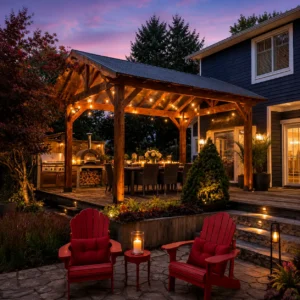
Outdoor living has become one of the most valued features of a modern American home, and a permanent pavilion sits at the center of that
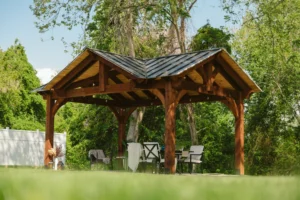
Some of the most memorable tasting experiences at wineries and breweries across the United States are not happening inside. They are happening under the open
It looks like you're visiting from Canada. We have a dedicated Canada site for you.
Take me to the Canada site