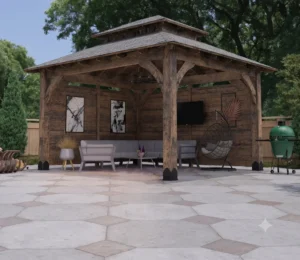
Timber Frame vs. Vinyl vs. Cedar: Comparing Materials for Pavilions and Pergolas
Outdoor structures have become a long-term feature of the American backyard, and the single decision that determines how long one lasts is rarely the roof



The best backyard gatherings rarely end when dinner is over. They continue under the glow of warm lighting, with conversations stretching late into the evening while the pavilion becomes the most inviting space on the property. The difference is rarely the furniture, the food, or even the weather. More often, it is the lighting.
A well-designed lighting plan transforms a pavilion from a structure you use during the day into an outdoor room you enjoy long after sunset. Soft overhead lighting creates atmosphere, task lighting makes outdoor cooking and dining easier, and accent lighting highlights the natural beauty of timber framing.
This is one area where a pavilion has a clear advantage over an open pergola. A solid roof and finished ceiling create opportunities for recessed fixtures, ceiling fans, pendants, and concealed wiring that simply are not possible with an open lattice structure.
In this guide, we’ll explore practical pavilion lighting ideas, fixture options, smart controls, and design strategies that help create a comfortable outdoor space you can enjoy throughout the year.
A pavilion’s solid roof expands your lighting options because it gives you a real ceiling to mount into and conceal wiring within. An open pergola can carry string lights and a few post-mounted fixtures, but its lattice top offers nowhere to recess a downlight or hide a cable run. A pavilion’s enclosed roof deck removes that limitation entirely.
With a finished ceiling overhead, you can install recessed downlights flush into the deck, hang a pendant or fan from a solid mounting point, and run wiring neatly through the beams rather than draping it in view. The heavy 8×8 Douglas Fir posts and tongue-and-groove roof deck on a NORWEH Pavilion HT give secure, load-rated fixing points that lightweight structures lack. That structural foundation is what lets a pavilion carry proper fixtures, not just decorative accents, which is the first reason a lighting-led outdoor room is worth building on a solid-roof pavilion rather than an open frame.
The outcome is a space you can light like an indoor room while keeping the open-sided, outdoor feel. That single difference, a ceiling you can build into, is why pavilion lighting can be layered, permanent and genuinely year-round.
The best pavilion lighting works in layers, combining three types of light so the space adapts to whatever you are doing. Relying on a single bright fixture leaves a pavilion either glaring or gloomy, whereas layering lets you shift from bright and practical to soft and relaxed without rewiring anything.
The first layer is ambient light, the general glow that fills the space, usually from recessed downlights or a central fixture in the ceiling. The second is task light, aimed where you actually do things, such as a pendant over the dining table or focused fixtures above an outdoor kitchen counter. The third is accent light, the low, warm touches like post sconces or perimeter string lights that set the mood once the working light is dimmed. Put on dimmers, these layers let one pavilion serve a family breakfast, a working dinner and a late evening with friends from the same wiring.
Choosing warm colour temperatures across these layers keeps the atmosphere inviting rather than clinical, and it is the simplest way to make a covered structure feel like a true outdoor living room.
The most effective outdoor pavilion lighting fixtures are the ones a solid roof is built to hold: recessed downlights, pendants, flush mounts, ceiling fans with integrated lights, and post-mounted sconces. Because a pavilion gives you a real ceiling and heavy timber posts, each of these can be installed securely and wired out of sight.
Recessed downlights sit flush in the Douglas Fir deck and deliver even, unobtrusive ambient light, which makes them the workhorse of most pavilion schemes. A pendant or a modest chandelier over a dining table anchors the space and doubles as task lighting where people gather. A ceiling fan with an integrated light is one of the highest-value additions a pavilion can take, since the solid roof deck and 8×8 posts provide the secure mounting a fan needs, and it earns its keep by moving air through the warm months and circulating heat in the cooler ones. Post-mounted sconces then wash the timber with soft light and define the edges of the room after dark. Every fixture used outdoors should be rated for damp or wet locations so it stands up to humidity and wind-driven rain.
Also Read: 10 Pergola Lighting Ideas to Set the Perfect Backyard Mood
Smart lighting allows the same pavilion to feel completely different depending on the season, occasion, or time of day. Rather than relying on a single brightness setting, homeowners can adjust lighting levels to match how the space is being used.
Dimmable fixtures make it easy to transition from bright task lighting while cooking to a softer atmosphere for relaxing after dinner. Adjustable colour temperatures allow lighting to feel crisp and energetic during the day and warmer and more inviting in the evening. Schedules and automated scenes can switch lights on at sunset, lower brightness later in the evening, or coordinate multiple fixtures with a single command.
When combined with the shelter of a timber frame pavilion, smart controls help create an outdoor living space that remains comfortable, functional, and welcoming throughout the year.
The strongest backyard pavilion ideas treat lighting as one layer of a fully considered outdoor room, working alongside heat, air and purpose. Lighting sets the mood, but it delivers the most when the space around it is designed for real use.
An outdoor kitchen pairs naturally with focused task lighting over the prep and cooking zone, so the pavilion works after dark as well as at midday. A fire feature is another strong match, and here the roof style matters: a Hip Roof Timber Frame Pavilion HT suits a fire pit particularly well, since its sloped roofline helps manage smoke and ember dispersal, while maintaining appropriate clearances and following local building and fire code requirements. For colder months, overhead or wall-mounted heaters extend the season, while Douglas Fir privacy walls block wind and add a sense of enclosure that makes soft lighting feel even more intimate. Around the perimeter, string lights or lanterns add the final warm layer without competing with the built-in fixtures.
Brought together, these elements turn a pavilion into a space that carries an evening in any season, with lighting as the thread that ties the experience together. Choosing the right roof style and size at the start is what leaves room for every one of these additions.
Browse the full NORWEH timber frame pavilion range to match a roof style and footprint to the outdoor room you have in mind.
The best time to plan pavilion lighting is before assembly, because it is far easier to route wiring and set fixture points while the frame is open than to retrofit them later. That makes the pavilion you choose part of the lighting decision, not a separate one.
Start by deciding what each area of the pavilion is for, then place light to match: even ambient coverage across the ceiling, task light over dining and cooking, and accent light at the posts and perimeter. Plan the runs so cabling can be concealed within the beams and roof deck for a clean finish, and position any ceiling fan or heavy pendant over a solid mounting point. Any hardwired fixtures and outdoor circuits should be installed by a licensed electrician to local code, using damp or wet-rated fittings and GFCI protection, while plug-in and solar options give a flexible, wiring-free way to fill in the accent layer.
A NORWEH Pavilion HT makes this straightforward from the start. It arrives as a pre-cut, engineer-approved kit with the solid deck and heavy posts that fixtures and fans mount into cleanly, ships free across the contiguous United States, and is backed by a 10-year structural warranty, with most customers needing no permit. With the roof style, size and finish chosen up front, you get a structure that is ready to wire and light exactly as you have planned, and financing through Affirm, including 0% plans, is available at checkout. Getting the structure right is what lets the lighting do its job for decades.
Also Read: What Makes a Pavilion Perfect for Backyard Entertaining?
A pavilion earns its keep in the evening, and its solid roof is what lets lighting go beyond a few strings of bulbs to a layered, year-round scheme of recessed fixtures, ceiling fans, sconces and smart controls. Plan those layers early, choose a structure built to hold them, and the space stays inviting long after the sun goes down, in every season.
Browse the NORWEH timber frame pavilion range to find a roof style and size that complement your lighting plans and outdoor space.
The best approach is layered lighting: ambient light overhead from recessed fixtures or a central fitting, task light over dining and cooking areas, and accent light from post sconces or perimeter string lights. Warm colour temperatures and dimmers let the same space shift from bright and practical to soft and relaxed. Layering is what lets one pavilion suit everything from a family meal to a late evening with friends.
Yes. A timber frame pavilion’s solid Douglas Fir roof deck and heavy 8×8 posts provide the secure, load-rated mounting a ceiling fan needs. Choose a fan rated for damp or wet outdoor locations, and a model with an integrated light doubles as a fixture while moving air in summer and circulating heat in cooler months.
Hardwired fixtures and outdoor circuits should be installed by a licensed electrician to local code, with damp or wet-rated fittings and GFCI protection. Plug-in and solar options, such as string lights and lanterns, need no wiring and can be added yourself. Planning the wiring runs before the pavilion is assembled makes any hardwired lighting far easier to install cleanly.
Any NORWEH Pavilion HT gives you the solid Douglas Fir roof deck and heavy 8×8 posts that recessed lights, fans and concealed wiring need. Choose the roof style to suit the room you want, such as a Hip Roof HT if a fire feature is part of the plan, then set your size and finish before ordering. Every kit is engineer-approved, ships free across the contiguous United States, and is backed by a 10-year structural warranty.
Outdoor structures have become a long-term feature of the American backyard, and the single decision that determines how long one lasts is rarely the roof
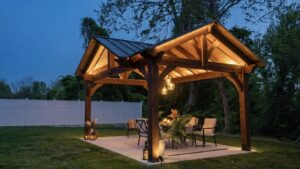
The best backyard gatherings rarely end when dinner is over. They continue under the glow of warm lighting, with conversations stretching late into the evening
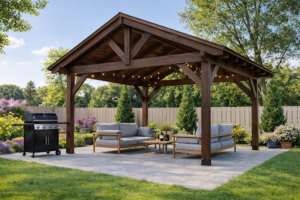
Planning a backyard pavilion is an exciting step, but somewhere between choosing a size and picturing the finished space, most homeowners run into the same
It looks like you're visiting from Canada. We have a dedicated Canada site for you.
Take me to the Canada site