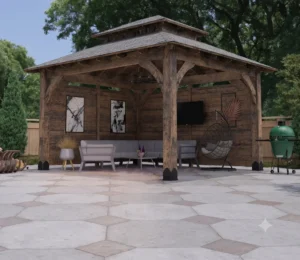
Timber Frame vs. Vinyl vs. Cedar: Comparing Materials for Pavilions and Pergolas
Outdoor structures have become a long-term feature of the American backyard, and the single decision that determines how long one lasts is rarely the roof



Outdoor structures have become a long-term feature of the American backyard, and the single decision that determines how long one lasts is rarely the roof style or the footprint. It is the material. Homeowners comparing a pavilion or pergola quickly find the same three options on nearly every quote: engineered timber frame, low-maintenance vinyl, and naturally weather-resistant cedar.
Each behaves very differently over a decade of sun, rain and temperature swings, which is why the question of the best wood for a pavilion deserves a clear, side-by-side answer rather than a sales pitch. A material that looks similar on day one can age in three very different ways once the seasons start working on it, and the difference shows up exactly when the structure is meant to be at its best.
This guide compares timber frame, vinyl and cedar across strength, roofing, maintenance and long-term value, and shows why a premium Douglas Fir kit is the option most buyers settle on once they weigh the full picture, so the choice you make is one you will still be satisfied with fifteen years from now.
The best wood for a pavilion is a structural-grade timber that combines high strength with dimensional stability, and Douglas Fir is the benchmark most serious builders return to. A pavilion carries a solid, permanent roof, so the frame beneath it has to hold real load year after year without sagging, twisting or loosening at the joints. That requirement immediately separates true structural timber from lighter decorative materials.
Douglas Fir earns its place because it is dense, strong and resistant to the warping that undermines cheaper softwoods over time. When that timber is joined with mortise and tenon joinery rather than relying on brackets and screws, the frame behaves as a single engineered unit, transferring load through the wood itself. The result is a structure that keeps its shape and its strength across decades of use, which is precisely what you are paying for in a permanent outdoor room.
For a pergola, the same logic applies in a lighter form. The open lattice roof carries less weight than a solid pavilion roof, but the posts and beams still define how straight and secure the structure stays. Choosing a strong, stable timber at the outset means the frame never becomes the weak point, whichever structure you build.
Vinyl is valued for one clear reason: low maintenance. It will not rot, it never needs painting, and a quick wash keeps it looking clean. For buyers who want to avoid upkeep entirely, that appeal is understandable and worth acknowledging honestly.
The trade-off sits in the structure itself. Vinyl is not a load-bearing material on its own, so a vinyl pavilion or pergola is typically a moulded sleeve or cladding wrapped around an internal support of aluminium or treated wood. The finish you see is doing very little of the structural work, which places a natural ceiling on span, size and long-term rigidity. Under years of direct UV and repeated temperature cycling, vinyl can also grow brittle, chalky or discoloured, and because the colour is set at manufacture, a weathered vinyl structure cannot be refinished or brought back. What you install is what you keep, and eventually what you replace.
For a smaller, purely decorative feature this can be an acceptable compromise. For a permanent outdoor room intended to anchor the backyard and add lasting value to the property, the limits of vinyl as a pavilion roof material become harder to design around.
In a Douglas Fir vs cedar comparison, both are respected outdoor timbers, but they solve different problems. Cedar’s strength is its natural chemistry: the wood contains oils that give it genuine resistance to rot and insects, and it is light and pleasant to work with. Its weakness is that it is comparatively soft, with lower structural strength, and left unsealed it weathers to a silver-grey and needs regular re-treatment to hold its original colour.
Douglas Fir approaches durability from the other direction. It is considerably stronger and denser than cedar. NORWEH builds its frames from Grade No. 1 Structural Douglas Fir, a timber it rates as roughly twice as strong as cedar, and one that resists the warping and movement that lead to loose joints over time. That structural margin is exactly what a solid pavilion roof depends on, and it is why the NORWEH Pavilion HT range is built around heavy 8×8 Douglas Fir posts and traditional mortise and tenon joinery rather than lighter framing. If you are also weighing an open structure, the NORWEH timber frame pergola is built from the same premium fir, so the strength advantage carries across the range.
Neither timber is maintenance-free, and both benefit from a protective finish. The practical difference is that Douglas Fir gives you a stronger frame to protect in the first place, which pays off across the full life of the structure.
Also Read: Is a Timber Frame Pavilion Worth the Investment for Your Home?
A pavilion’s roof is built in two layers, and it helps to separate them. The structural deck is the timber that spans the frame; on a NORWEH pavilion this is a tongue-and-groove Douglas Fir roof deck that ties the whole roof together. Over that deck sits the weatherproof covering, and this is where you choose the finished look, most often architectural shingles or standing-seam metal. NORWEH ships the timber frame and deck pre-cut and engineer-approved, while the owner selects and installs the final roofing materials to match the home.
Pergola materials follow a lighter version of the same idea. Instead of a solid deck, a NORWEH timber frame pergola carries an open lattice of stained 2×6 shade boards, which filters sunlight and keeps the airy, open-top character that defines a pergola. There is no shingled or metal roof to specify, because shade rather than shelter is the goal.
Understanding this layered structure clarifies the comparison. With timber, the roof material is a considered choice you make on top of a strong deck. With vinyl, the roof and the structure are effectively the same limited component, which is a large part of why the two age so differently.
Longevity is decided less by the material’s first impression and more by how it responds to weather over time. Cedar and Douglas Fir both need periodic sealing, but a quality penetrating finish makes that straightforward. NORWEH timbers arrive pre-finished with CUTEK penetrating oil stain, which soaks into the wood rather than forming a surface film that can peel, so refreshing the finish is a wash-and-recoat task rather than a strip-and-repaint project. Because the finish penetrates, a timber structure can also be recoloured or refreshed years later, and NORWEH offers natural Douglas Fir along with Walnut and Black Ash tones so the structure can be matched to the home from day one.
Vinyl asks for less routine attention, which is its genuine advantage, but it offers no path to renewal once it fades or grows brittle. Cedar left unsealed will survive but silver over and soften cosmetically. Douglas Fir, sealed and cared for with a light re-oil every few seasons, holds both its strength and its appearance across decades.
Seen across a fifteen or twenty-year horizon, the choice is really between a material you maintain and can renew, and a material you replace when it wears out.
Long-term value comes down to cost spread across lifespan, and a strong, renewable timber frame consistently earns its place here. A pavilion or pergola built from structural Douglas Fir is a permanent addition to the property, engineered to perform for decades and backed by warranty rather than treated as disposable, which changes how the initial figure should be read.
NORWEH Timber Frame offers a purpose-built Heavy Timber range to suit different properties and budgets, in four roof configurations. The Hip Roof HT and Double Hip Roof HT start from $11,105, the Two Gable HT from $12,509, and the Three Gable HT from $14,144, scaling up to larger 24×36 footprints. Every structure is built from Grade No. 1 Structural Douglas Fir, arrives pre-cut and engineer-approved, and ships with free freight across the contiguous United States and a 10-year structural warranty.
Set against a vinyl structure that cannot be renewed, or a softer cedar frame that trades some strength for its natural finish, heavy Douglas Fir gives you the strongest starting point and the longest runway. For most homeowners weighing the three, that combination of durability, renewability and warranty is what turns the material decision into a straightforward one.
Yes, and this is where the timber option often surprises buyers who expect a custom build to mean months of construction. A NORWEH pavilion arrives as a complete kit: every structural timber is pre-cut to exact dimensions, pre-numbered to match the assembly manual, and pre-finished, so much of the work that makes bespoke timber framing expensive is already done before the kit reaches your yard. Many homeowners assemble a kit over a weekend, and those who prefer a hands-off route can hand the same kit to a contractor for a fast install.
The supporting details are designed to remove the usual friction from a large purchase. Shipping is free across the contiguous United States, every structure is engineer-approved, and the majority of customers need no permit, with documentation available on request where one is required. Financing is available through Affirm, including 0% interest plans selected at checkout, which spreads the investment without adding cost. And with four roof styles, a range of sizes and a choice of natural Douglas Fir, Walnut or Black Ash finishes, you can match the structure to your property and budget before you order.
Explore the full NORWEH timber frame pavilion range to compare roof styles side by side and find the configuration that fits your property.
Across strength, roofing, maintenance and long-term value, the three common materials pull in different directions: vinyl minimises upkeep but cannot be renewed, cedar offers natural resistance but trades away structural strength, and heavy Douglas Fir delivers the strongest, most renewable frame of the three. For a pavilion or pergola meant to anchor the backyard for decades, that structural margin, backed by a kit that is engineer-approved, free-shipped and warrantied, is what makes the decision clear.
Explore the full NORWEH timber frame pavilion range to see how each roof style pairs with premium Douglas Fir, and find the configuration built to last.
For a pavilion, Douglas Fir generally holds up better because it is considerably stronger and denser than cedar, which matters when the frame supports a solid, permanent roof. Cedar offers strong natural rot resistance and a lighter feel, but its lower structural strength makes it better suited to lighter or decorative builds. NORWEH frames are built from Grade No. 1 Structural Douglas Fir for exactly this reason.
No. Vinyl is prized for low maintenance, but it is not a structural material on its own, so vinyl pavilions are usually a sleeve over an internal aluminium or wood support. That limits span, size and long-term rigidity, and vinyl cannot be refinished once it fades or grows brittle. A structural Douglas Fir frame carries load through the timber itself and can be renewed over time.
A pavilion roof is best built in two layers: a solid structural deck, such as NORWEH’s tongue-and-groove Douglas Fir roof deck, topped with a weatherproof covering of your choice, most often architectural shingles or standing-seam metal. The deck provides the strength, while the covering sets the finished look and matches the home. A pergola uses open lattice shade boards instead, since it is designed for filtered light rather than full shelter.
Not a great deal. A timber frame pavilion needs periodic re-oiling with a penetrating finish rather than repeated painting, which is far less demanding than many buyers expect. NORWEH timbers arrive pre-finished with CUTEK penetrating oil stain, so refreshing the finish every few seasons is a wash-and-recoat task that keeps both the strength and the appearance intact.
Yes, significantly. The timber’s structural strength and how well it takes a protective finish together determine how long the frame stays true and sound. Heavy Douglas Fir joined with mortise and tenon joinery and sealed with a penetrating stain is built to perform for decades, which is why NORWEH backs its structures with a 10-year structural warranty.
Yes. A NORWEH pavilion ships as a pre-cut, pre-numbered, engineer-approved kit with free freight across the contiguous United States, ready for weekend assembly or a quick contractor install. Financing is available through Affirm, including 0% interest plans at checkout, so the investment can be spread without adding cost.
Outdoor structures have become a long-term feature of the American backyard, and the single decision that determines how long one lasts is rarely the roof
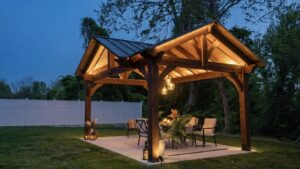
The best backyard gatherings rarely end when dinner is over. They continue under the glow of warm lighting, with conversations stretching late into the evening
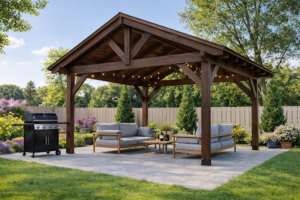
Planning a backyard pavilion is an exciting step, but somewhere between choosing a size and picturing the finished space, most homeowners run into the same
It looks like you're visiting from Canada. We have a dedicated Canada site for you.
Take me to the Canada site