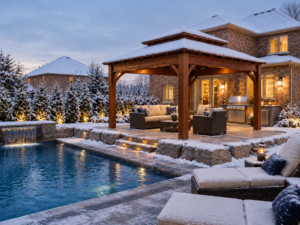
How to Extend Your Pavilion Season Into Fall and Winter
For most American households, the outdoor season has traditionally followed the calendar: the patio furniture comes out in May and goes back into storage by



Outdoor living has become one of the most valued features of a modern American home, and a permanent pavilion sits at the center of that shift. For anyone weighing the decision, the first and most practical question is a straightforward one: how much does a pavilion cost, and what does that actually include? The honest answer is that pavilion cost varies widely, because a pavilion is not a single product but a category that spans lightweight seasonal kits and fully engineered heavy timber structures built to last for decades.
Understanding where your budget lands within that range starts with understanding the factors that drive it. This guide breaks down what actually determines the price, what homeowners typically spend across different sizes and build types, how a pergola compares, and how to estimate a realistic figure for your own backyard before you commit.
Pavilion cost is shaped by five main factors: size, material, roof style, construction method, and how the structure is installed. Each one moves the final figure meaningfully, which is why two pavilions with the same footprint can differ in price by thousands of dollars.
Size is the most obvious driver. A larger footprint requires more material, heavier posts and beams, and a more substantial foundation, and each of those scales the cost upward. Material is the next major factor. A pressure-treated pine structure sits at the affordable end, cedar occupies the middle, and heavy timber built from premium species such as Douglas Fir commands a higher figure because of both the material itself and the craftsmanship it requires.
The roof style and how the pavilion is built also affect the price. A pavilion with an open roof costs less than one with a solid roof, and a basic bolt-together kit costs less than one built with the mortise and tenon joinery that lasts for decades. Finally, installation and add-ons like concrete footings, electrical, lighting, ceiling fans, or an outdoor kitchen can add several thousand dollars on their own. Reading pavilion cost through these five lenses is the clearest way to compare quotes fairly rather than reacting to a single headline number.
The single biggest factor behind pavilion cost is what the structure is actually built from, and that splits the market into two very different tiers. At the lighter end sit metal-framed and basic pressure-treated pine kits, which can start around $2,000 to $8,000 but are built for seasonal, shorter-term use rather than decades of performance. At the durable end sits heavy timber — the substantial, permanent, post-and-beam construction most buyers picture when they imagine a genuine pavilion.
Heavy timber is a different category, and it is priced accordingly. A custom-built timber frame pavilion typically runs from around $16,000 for a mid-size structure to $35,000–$48,000 or more for larger footprints, because it uses larger, higher-grade beams, skilled joinery, engineering, and on-site labour. Comparing a heavy timber pavilion against a lightweight metal kit is not a like-for-like comparison, because the two are built to different standards and last for very different lengths of time. The more useful question is how to secure genuine heavy timber construction without paying the full custom-build pavilion cost.
A direct-to-consumer timber frame kit delivers the same heavy timber construction as a custom build for a fraction of the price, because it removes the bespoke design fees, fabrication overhead, and on-site labour that make custom builds so expensive. This is where the timber frame pavilion price equation shifts decisively in the buyer’s favour.
The NORWEH Heavy Timber pavilion range starts from $9,959 and spans four roof styles, scaling up to larger 24×36 configurations. Every model is built from Grade No. 1 structural Douglas Fir with precision mortise and tenon joinery, and arrives pre-cut, pre-drilled, and pre-treated for straightforward assembly. Set against custom timber frame builds of $16,000 to $48,000 or more, that places authentic heavy timber craftsmanship at roughly half the cost of an equivalent contractor build, and often less.
The value extends well beyond the sticker price. Every NORWEH structure ships free across the contiguous United States, is engineer-approved, and is backed by a 10-year structural warranty, with more than 800 completed projects and a 4.8-star customer rating behind it. For a homeowner who wants a permanent, heavy timber pavilion without the custom-build premium, that combination of price, material, and assurance is difficult to match.
Also Read: Is a Timber Frame Pavilion Worth the Investment for Your Home?
A pergola generally costs less than a pavilion because it is a fundamentally lighter structure. In 2026, most homeowners pay between roughly $2,100 and $6,400 for a professionally installed pergola, with basic DIY kits starting near $700 to $3,000 and high-end motorised louvered systems climbing well beyond $15,000. The gap between the two structures comes down to what each one is built to do.
A pergola has an open or slatted roof designed primarily to define a space and filter sunlight, which keeps material and engineering requirements modest. A pavilion, by contrast, has a solid, permanent roof engineered to shed rain and snow and to remain usable in all conditions, and that structural difference is where the additional cost sits. So the more useful question is rarely which is cheaper, but which the space is meant to do. If the goal is a genuine outdoor room that works through every season, the higher pavilion cost buys a level of shelter and permanence a pergola is not designed to match.
The most reliable way to estimate pavilion cost without a formal backyard pavilion cost calculator is to work through the same variables a builder would price: footprint, material, roof type, foundation, and any utilities or add-ons. Start with the size you realistically need, apply a per-square-foot range for your chosen material, then add fixed costs such as footings, electrical, and finishing on top.
For a custom build, each of those variables introduces uncertainty, which is why quotes for the same pavilion can differ so widely between contractors. A pre-engineered kit removes most of that guesswork. Because the timbers arrive pre-cut and the design is fixed and engineer-approved, the structural cost is known upfront, and the only remaining variables are your foundation and any optional features you choose to add. That predictability is one of the quieter advantages of the kit model: it turns a moving estimate into a firm figure, which makes budgeting for the rest of the project far more straightforward.
The best value is the pavilion that fits the full range of ways you will use the space over its lifetime, not simply the one with the lowest sticker price. A structure that feels adequate today can become a constraint within a few seasons as entertaining and outdoor living expand, so it is worth sizing for where you are heading rather than only where you are now.
NORWEH Timber Frame offers a purpose-built heavy timber range to suit different properties and budgets, with four roof configurations to match different settings. The Hip Roof HT and Double Hip Roof HT start from $9,959, the Two Gable HT from $11,235, and the Three Gable HT from $12,722, scaling up to larger 24×36 footprints. Every structure is built from Grade No. 1 structural Douglas Fir, arrives pre-cut and engineer-approved, and comes with free shipping across the contiguous United States and a 10-year structural warranty, details that protect the value of the investment long after the pavilion is standing.
Also Read: Which Pavilion Size Is the Right Fit for Your Backyard?
Pavilion cost ultimately reflects a choice between short-term price and long-term value. A lightweight structure may cost less today, but a permanent, well-engineered pavilion delivers the shelter, durability, and property value that make the investment pay back across seasons and years. Understanding the factors behind the figure size, material, roof, construction, and installation is what turns an uncertain estimate into a confident decision.
Explore the full NORWEH timber frame pavilion range to find the configuration and price point that fit your property, and start planning an outdoor space built to last.
Pavilion cost depends heavily on what the structure is built from. Lightweight metal or basic pine kits can start around $2,000 to $8,000 but are built for shorter-term use, while durable heavy timber pavilions are a different category: custom timber frame builds typically run $16,000 to $48,000 or more. NORWEH’s direct-to-consumer heavy timber kits deliver that same construction from $9,959, removing the custom-build premium.
A timber frame pavilion costs more than a lightweight metal or pine kit because it uses larger, higher-grade beams and skilled joinery built to last for decades. A pre-engineered kit closes much of that gap, however: NORWEH delivers genuine Douglas Fir heavy timber from $9,959, roughly half the cost of an equivalent custom timber frame build of $16,000 to $48,000 or more.
A pergola generally costs less, with most professionally installed pergolas running $2,100 to $6,400 in 2026, because it has an open roof and lighter structural requirements. A pavilion costs more because its solid, permanent roof is engineered for year-round shelter and heavier loads.
Yes. Pavilion kits are typically less expensive than custom builds because they remove on-site fabrication, bespoke design, and much of the installation labour. The timbers arrive pre-cut and engineer-approved, which fixes the structural cost upfront and makes the overall project easier to budget.
A well-built, permanent pavilion is widely recognised by appraisers and buyers as a structural improvement rather than a decorative addition, particularly in markets where covered outdoor living is expected. Combined with years of added usability and enjoyment, that contribution to property value is a central reason many homeowners consider the pavilion cost worthwhile.
For most American households, the outdoor season has traditionally followed the calendar: the patio furniture comes out in May and goes back into storage by
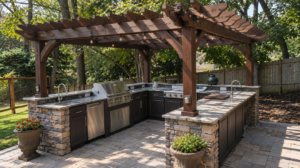
The outdoor kitchen has moved from a luxury add-on to one of the most considered upgrades in the American backyard, and more homeowners are now
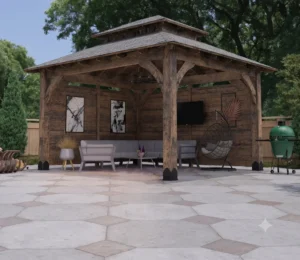
Outdoor structures have become a long-term feature of the American backyard, and the single decision that determines how long one lasts is rarely the roof
It looks like you're visiting from Canada. We have a dedicated Canada site for you.
Take me to the Canada site